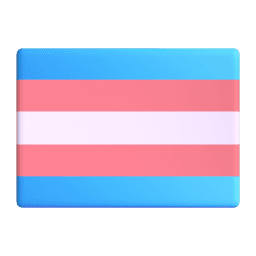
transgender flag

🏳️‍⚧️

transgender flag

Represents the transgender flag, featuring light blue, pink, and white horizontal stripes. This flag is widely used to represent transgender people and gender-diverse identities. It can be used to express personal gender identity, visibility, or support for the transgender community in conversations, profiles, and online spaces.

  • You are sharing a post on social media to celebrate Pride Month.

    Celebrating Pride Month today 🏳️‍⚧️🏳️‍🌈💖

Groups
Subgroups
Unicode
U+1F3F3 U+FE0F U+200D U+26A7 U+FE0F
Variant status
Fully-qualified
Emoji version
E13.0
General

This emoji was officially added to the emoji set in 2020, alongside other symbols related to transgender identity, including the transgender symbol ⚧️ commonly seen in public signage and representations. Its inclusion coincided with a period in which transgender topics were increasingly entering public awareness and mainstream discussion in many countries. As a result, the emoji came to represent not only identity, but also a broader moment of visibility for gender identity as a distinct concept.

Prior to this, most LGBTQ-related emoji focused primarily on sexual orientation rather than gender identity itself. While the addition was seen as a radical change by some at the time, it also reflects a wider cultural shift toward recognizing gender diversity in everyday digital communication.

General

Supplementary reading – Gender vs. Sex

In discussions about transgender identity, it is common to distinguish between sex and gender. Sex usually refers to biological characteristics, while gender refers to a person’s internal identity and social role. This distinction helps explain why gender identity is discussed separately from biological sex in many cultural and social contexts.

General

Supplementary reading – Why the term “transgender” is used

The term transgender focuses on gender identity rather than biological sex. It is used because transgender experiences relate to how a person identifies and lives socially, not to a change of biological sex. This framing helps explain why transgender identity is widely regarded as legitimate in contemporary discussions, as it describes identity and lived experience rather than making a biological claim.

You may also want to check out

Related emojis that share similar meanings or usage.

ZWJ Composition

See how 🏳️‍⚧️ is built from its components, split by zero-width joiner (ZWJ).

🏳
U+1F3F3
ZWJ
U+26A7