no one under eighteen

๐Ÿ”ž

no one under eighteen

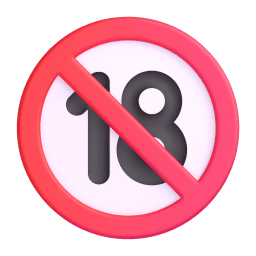
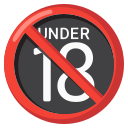
๐Ÿ”ž represents no one under eighteen, typically shown as a red prohibition sign with the number 18 inside. Some designs also include the word under above the number.

No one under eighteen is a regulatory sign used to restrict access to content, products, or venues based on age. It serves as a universal warning that the associated material is intended for adults only and may be inappropriate or legally restricted for minors.

In digital communication, ๐Ÿ”ž is frequently used to flag mature topics or age-gated events. Common usage includes phrases such as "This thread is ๐Ÿ”ž only," "Please note the ๐Ÿ”ž rating on this video," or "You must be ๐Ÿ”ž to enter this club."

Groups
Subgroups
Unicode
U+1F51E
Variant status
Fully-qualified
Emoji version
E0.6

You may also want to check out

Related emojis that share similar meanings or usage.

๐Ÿšซ
prohibited

๐Ÿšซ represents prohibited, typically shown as a red circle with a diagonal slash. Designs vary in shading and detail, with some looking more three-dimensional and others flat. Prohibited is a universal warning symbol used to signify that an action, item, or entry is disallowed. It is designed with thick red lines to ensure it is highly visible and immediately understood as a restrictive command regardless of language. In digital communication, it is frequently used to set boundaries or express disapproval. Common examples of its use include: "Sorry, ๐Ÿšซ no photos allowed here," "That behavior is ๐Ÿšซ strictly forbidden," or "I am ๐Ÿšซ not interested in that option."

โ›”
no entry

โ›” represents no entry, typically shown as a red circle with a white horizontal bar across the center. No entry is a regulatory sign primarily used to inform drivers and pedestrians that they are not permitted to enter a specific area. It is a universal symbol for restriction, ensuring safety and order by managing the flow of traffic and people in both physical and digital spaces. In common communication, the emoji is used to signal a hard stop, a forbidden action, or a restricted zone. Examples of its use include: "Sorry, this area is โ›”," "Please โ›” do not go any further," or "That topic is โ›” off-limits for now."

๐Ÿšญ
no smoking

๐Ÿšญ represents no smoking, typically shown as a red prohibition sign with a diagonal slash over a cigarette and smoke. No smoking signs are used globally to mark areas where tobacco use is strictly prohibited for safety or health reasons. This graphic serves as a universal command that transcends language, ensuring that the restriction is understood by everyone in a specific vicinity regardless of their native tongue. In digital communication, ๐Ÿšญ is frequently used to denote smoke-free policies or to express a dislike for tobacco. Common usage includes: "Please remember this is a ๐Ÿšญ building," "I prefer booking a ๐Ÿšญ room for the trip," or "The entire campus is now a ๐Ÿšญ zone."

โš ๏ธ
warning

โš ๏ธ represents warning, typically shown as a yellow triangle with a black exclamation mark. Designs vary in shading and outline, with some looking more three-dimensional and others flat. A warning sign is a universal indicator used to signal potential danger, hazards, or technical errors. It relies on the high-contrast yellow and black color scheme to capture immediate attention and prompt the viewer to proceed with caution. In digital communication, โš ๏ธ is frequently used to flag important notices or risks. Common usage includes phrases like "โš ๏ธ High voltage area ahead," "Please read the โš ๏ธ safety instructions carefully," or "โš ๏ธ Error: your changes were not saved."

๐Ÿšท
no pedestrians

๐Ÿšท represents no pedestrians, typically shown as a red circle with a diagonal slash over a walking person silhouette. Designs vary in shading and detail, with some appearing flat and others slightly dimensional. No pedestrians is a regulatory sign used to indicate that foot traffic is strictly prohibited in a specific area. It is most commonly found in locations where walking would be dangerous or would interfere with high-speed vehicle traffic, such as highways, industrial zones, or construction sites. In digital communication, this emoji is used to signal restricted access or to warn others about forbidden paths. For example: "The road is closed, ๐Ÿšท," "Don't walk through the construction zone ๐Ÿšท," or "This area is for cars only ๐Ÿšท."