flag: Mayotte

๐Ÿ‡พ๐Ÿ‡น

flag: Mayotte

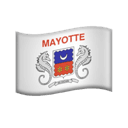
๐Ÿ‡พ๐Ÿ‡น represents the flag of Mayotte, depicting a white field with a central coat of arms flanked by two grey seahorses. Some designs appear flat and static while others add folds, shading, or wave-like motion to simulate a flag in the wind.

Mayotte is a French overseas department situated between Madagascar and Mozambique. The central shield contains a crescent moon and ylang-ylang flowers, symbolizing the island's traditions, while the seahorse supporters represent the island's shape and its rich lagoon environment.

This emoji is commonly used to denote local identity in the Indian Ocean region. It is often used in travel photography, geographic tagging, or when discussing regional sports and cultural festivals.
Groups
Subgroups
Unicode
U+1F1FE U+1F1F9
Variant status
Fully-qualified
Emoji version
E2.0

You may also want to check out

Related emojis that share similar meanings or usage.

๐Ÿ‡ท๐Ÿ‡ช
flag: Rรฉunion

๐Ÿ‡ท๐Ÿ‡ช represents the flag of Rรฉunion, which has a blue field with a red triangle at the bottom center and four yellow rays radiating toward the edges. Some designs appear flat and static while others add folds, shading, or wave-like motion to simulate a flag in the wind. Rรฉunion is an overseas department of France located in the Indian Ocean, known for its dramatic volcanic terrain. The red triangle symbolizes the Piton de la Fournaise volcano, while the blue field and yellow rays represent the sea and the sun, reflecting the island's natural identity and vibrant energy. This emoji is often used to signify local pride, cultural events, or travel experiences on the island. It serves as a clear marker for regional geography and sports representation in digital spaces.

๐Ÿ‡ซ๐Ÿ‡ท
flag: France

๐Ÿ‡ซ๐Ÿ‡ท represents the flag of France, which consists of three equal vertical bands of blue, white, and red. Some designs appear flat and static while others add folds, shading, or wave-like motion to simulate a flag in the wind. France is a major European nation known for its deep history and influence. The vertical triband design uses blue and red to represent Paris, while white signifies the monarchy. This combination has become a global symbol of national identity and republican values. It is often used to discuss travel, French cuisine, or international sports. This emoji also serves as a shorthand for the French language in multilingual settings.

๐Ÿ‡ฒ๐Ÿ‡บ
flag: Mauritius

๐Ÿ‡ฒ๐Ÿ‡บ represents the flag of Mauritius, which displays four horizontal bands of red, blue, yellow, and green. Some designs appear flat and static while others add folds, shading, or wave-like motion to simulate a flag in the wind. Mauritius is a diverse island nation located in the Indian Ocean. The red band symbolizes the struggle for freedom, while blue represents the surrounding ocean, yellow signifies the light of independence, and green reflects the island's lush vegetation. These four bands together represent a unified national identity. This emoji is commonly used to denote Mauritian heritage, travel plans to the island, or support for the nation in global sports. It is often used as a shorthand for Mauritian culture and geographical location.

๐Ÿ‡ผ๐Ÿ‡ซ
flag: Wallis & Futuna

๐Ÿ‡ผ๐Ÿ‡ซ represents the flag of Wallis & Futuna, which is a red field with the French tricolor in the canton and a white square containing a red saltire. Some designs appear flat and static while others add folds, shading, or wave-like motion to simulate a flag in the wind. Wallis and Futuna is a French overseas collectivity located in the South Pacific between Fiji and Samoa. The red field serves as the primary background, while the white cross in the fly side is a traditional emblem of the islands, symbolizing the local cultural identity alongside the administrative connection to the French Republic. This emoji is often used in social media bios to denote heritage or during major regional events like the Pacific Games. It is the standard visual representation for topics involving the territory's geography, travel, and local governance.

๐Ÿ‡ฒ๐Ÿ‡ถ
flag: Martinique

๐Ÿ‡ฒ๐Ÿ‡ถ represents the flag of Martinique, which uses a white cross to divide a dark blue field into four quadrants, each containing a white 'S' shaped snake. Some designs appear flat and static while others add folds, shading, or wave-like motion to simulate a flag in the wind. Martinique is a French overseas department located in the Lesser Antilles of the eastern Caribbean Sea. The white snakes in the design represent the fer-de-lance, a venomous viper native to the island, arranged within a traditional maritime cross layout. This emoji is often used to signify regional identity during cultural festivals or to denote the island's location in travel-related posts. It serves as a visual shorthand for Martinican heritage in sports, tourism, and Caribbean geography discussions.