
fight cloud

fight cloud

fight cloud

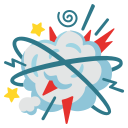
fight cloud emoji noto fight cloud, usually shown as a rolling cloud of gray or white dust mixed with stars, small spirals, or splash symbols. It mimics the classic visual effect of cartoon characters scuffling.

It is commonly used for physical fights, heated arguments, or a generally chaotic situation. Beyond literal conflicts, it is often used to joke about a stressful workday, a flooded group chat, or playful bickering among friends, giving it a funny and exaggerated tone rather than a seriously violent one.

In chats and captions, you can use it to describe a messy situation at work, such as β€œThe meeting turned into a total mess over the project details fight cloud emoji noto.” For playful bickering with a friend, you could write β€œIf you steal my snacks again, we are going to fight fight cloud emoji noto.” When sharing a funny moment about pets acting up, it can also appear in β€œThe two cats are fighting over a single treat again fight cloud emoji noto.”

  • You see two friends arguing loudly in a group chat.

    Did I just walk into a battlefield? 🫯

Subgroups
Unicode
U+1FAEF
Variant status
Fully-qualified
Emoji version
E17.0
Heads-up

This emoji was approved in 2025 under Unicode 17.0 and is expected to roll out gradually in late 2025 – 2026. Some devices or systems might not support it yet, so it may appear as a blank box or garbled character. Check compatibility before you send it.

Compare picks

See what they share and how they differ to choose the right one.

Differences between 🫯 (fight cloud) and πŸ’₯ (collision)

Both depict bursts of action and impact in a compact visual. 🫯 conveys a clash or heated moment, a cloud of dust that implies tension and conflict. πŸ’₯ reads as sudden impact and explosive energy, more dramatic and immediate than 🫯. The tone of πŸ’₯ is attention grabbing and kinetic, almost comic in its intensity. While 🫯 suggests interpersonal friction and lingering disagreement, πŸ’₯ signals an abrupt event that breaks through the moment.

Usage

Use 🫯 fight cloud when describing a heated argument, simmering tension, or interpersonal clash where emotion and aftermath matter. Use πŸ’₯ collision when you need to signal an abrupt impact, explosive surprise, or energetic, comic effect that demands immediate attention.

You may also want to check out

Related emojis that share similar meanings or usage.

πŸ’₯
collision

πŸ’₯ collision, usually shown as a sharp starburst shape with a bright center and jagged edges. The collision emoji is commonly used to represent an explosion, a sudden impact, or a figurative burst of energy. It can refer to a physical crash, a loud noise, or a major announcement that comes with a 'bang.' Because of its comic-book origins, it often feels energetic and impactful, making it a popular choice for emphasizing something exciting, shocking, or intense in a conversation. In chats and captions, you can use it for a surprising announcement, such as β€œCheck out this πŸ’₯ big news I just heard!” For a literal impact or accident, you could write β€œI accidentally dropped my phone πŸ’₯ on the floor.” In a more positive context, it can also appear in β€œThe party last night was a total πŸ’₯ blast.”

πŸ’ž
revolving hearts

πŸ’ž revolving hearts, usually shown as two hearts linked by curved lines in a swirling, romantic design. The revolving hearts emoji is commonly used to express mutual love, shared affection, or a deep emotional connection. It can refer to the feeling of being dizzy with love, a blossoming romance, or a playful and lively emotional state. Because of the circular lines, it feels romantic and passionate, often suggesting that love is growing or moving between two people rather than just being a static feeling. In chats and captions, you can use it for a romantic message, such as β€œThinking of you makes my head spin πŸ’ž with happiness.” For a caption about close friendship, you could write β€œBest friends forever πŸ’ž, so glad to have you in my life.” In a reaction to a cute couple photo, it can also appear in β€œYou two are absolutely perfect πŸ’ž together!”

πŸ’”
broken heart

πŸ’” broken heart, usually shown as a red heart split by a jagged crack down the middle. The broken heart emoji is commonly used to represent heartbreak, emotional pain, and the end of a relationship. It can refer to romantic rejection, a breakup, or a deep sense of longing and sadness. It often suggests a sad or hurt tone, though it can also be used figuratively to express disappointment or feeling upset about bad news that isn't necessarily romantic. In chats and captions, you can use it for a romantic message about a breakup, such as β€œI’m still trying to process everything πŸ’” after we part ways.” For a reaction to sad news, you could write β€œIt’s so hard to hear that the local bookstore is closing πŸ’”.” In a post about missing someone, it can also appear in β€œI really wish you were here with us πŸ’” today.”

πŸ—―οΈ
right anger bubble

πŸ—―οΈ right anger bubble, usually shown as a jagged speech bubble with sharp, explosive edges and a pointed tail. The right anger bubble emoji is commonly used to express intense anger, yelling, or sudden shouting. It originates from comic books where its jagged edges represent loud and aggressive dialogue. Because of this, it feels aggressive and loud, often used to signify that the sender is making a sharp, explosive point or is in the middle of a frustrated outburst. In chats and captions, you can use it for an angry outburst, such as β€œI told you not to touch my things! πŸ—―οΈβ€ For a frustrated reaction to a mistake, you could write β€œI cannot believe I missed the train again πŸ—―οΈ!” In a post about a heated debate, it can also appear in β€œThe argument πŸ—―οΈ got out of hand very quickly.”

πŸ’¬
speech balloon

πŸ’¬ speech balloon, usually shown as a rounded chat bubble with three dots inside. The speech balloon emoji is commonly used to represent active speech, conversation, or the act of typing a message. It can refer to a comic-book style dialogue bubble, indicating that someone is speaking or thinking out loud. It gives a communicative and social feeling, and it is often used to show that a person is ready for a chat or is waiting for a response. In chats and captions, you can use it for a casual greeting, such as β€œLet’s catch up soon πŸ’¬ and grab some coffee.” For a reaction to a long story, you could write β€œI have so much to tell you πŸ’¬ about my trip!” In an invitation to talk, it can also appear in β€œFeel free to DM me πŸ’¬ if you have any questions.”